Renting a bus without an agent: Why traditional bus brokers are expensive and slow
Traditional bus brokers add high margins, push down operator prices and stretch every request into days of email back-and-forth. Why a direct platform like Busly works better for everyone – and where classic brokers still have their place.
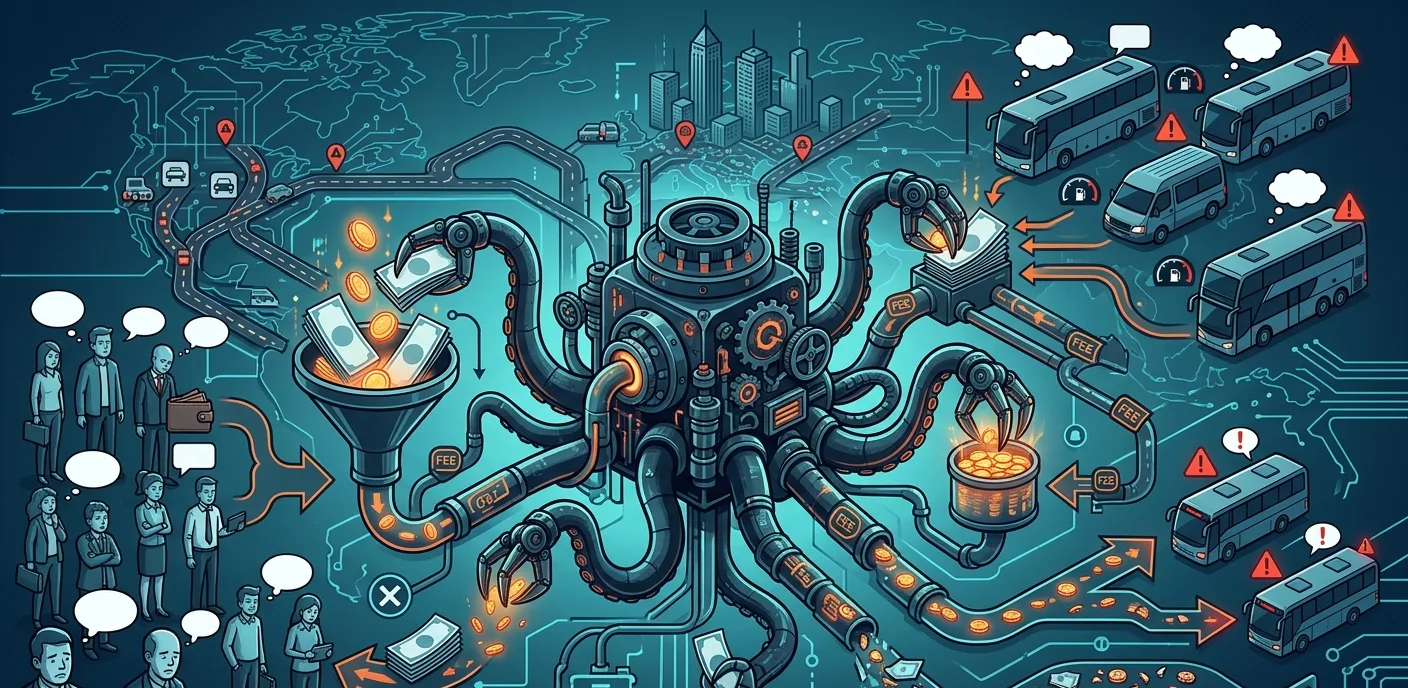
How traditional bus brokers operate today
Germany has a long list of bus agencies and coach brokers sitting between customers and bus companies. The model has been the same for decades: you write an email, describe your trip, the broker collects offers, adds their margin, sends you a quote. Sounds simple – but it no longer is, in a world where booking a hotel, rental car or flight takes seconds.
The issues aren't personal, they're structural. Three of them stand out when you look at the market in 2026.
Problem 1: Margins nobody explains
Traditional bus brokers earn through the gap between the price the bus company accepts and the price the customer ends up paying. Neither side is told transparently how big that gap is.
From the broker's perspective that's logical: the larger the gap between purchase and sale price, the higher the profit. In practice it means:
- The bus operator is pushed to the lowest price, because otherwise the broker earns less
- The customer pays the highest price the broker thinks the market will tolerate
- Both sides don't know which share of the final price actually reaches the operator
The result: industry conversations regularly note that broker bookings are barely profitable for operators. Customers tend to pay more than they would on a direct booking. The only structural winner is the middleman – in a setup that's no longer fit for purpose.
On Busly it works differently: the commission is fixed and transparent up front. The provider knows exactly what they receive. The customer knows exactly what they pay. There's no hidden gap for anyone to maximise.
Problem 2: Bureaucratic hell and email ping-pong
The second structural weakness of traditional brokers is the lack of digitisation – and it hits both sides, just in different ways.
From the customer's side:
- You email the agency with date, route, passenger count
- The agency forwards the request to three or four bus companies – also by email
- Each company manually replies with a price, if at all
- The agency collects the responses, adds their margin, sends you the quote
- You ask for an adjustment (two hours later, slightly different route), the whole loop starts over
This easily takes three to seven business days. Anyone who's ever tried to book a coach for a school trip or club outing on short notice knows the frustration.
From the bus operator's side:
- Requests arrive as unstructured emails in an overflowing inbox – route half described, passenger count unclear
- No direct contact with the customer for clarifications, everything has to go through the agency as a phone/email game
- Replies vanish into the agency's inbox, often with no feedback on whether the job was awarded
- No visibility into who you're competing against or at what price
- Effort flows into a black box: hours of manual quoting for requests that 80 percent never convert into bookings
Both sides lose time, nobody has the overview.
On Busly the request reaches the operator within minutes, structured in their dashboard, with direct customer contact for follow-ups. The operator can reply directly or use our AI price calculator. You as customer get offers back that you compare directly – no middleman taking two days to write an email.
Problem 3: Nobody is actually happy
A market where the broker pushes the operator's price down and the customer's price up creates structural dissatisfaction on both sides:
- Industry conversations frequently note that broker jobs rank among the less attractive ones for operators
- Customers point out prices noticeably higher than what they'd pay booking direct with the same operator
- Both sides often feel the broker's value-add isn't proportional to the margin retained
This dissatisfaction was one of the reasons we built Busly.
What Busly does differently
We're not brokers – we're a platform with transparent rules. Concretely:
- Fixed commission instead of variable margin: the operator knows up front exactly what percentage goes to the platform
- Direct contact between customer and operator, no middleman taking days to respond
- Real comparability: you see multiple offers in one view and decide yourself
- Digital dashboard for operators: requests arrive structured, both established family businesses and newcomers to the bus business work with the same tools
- AI-powered price calculation so operators set fair prices instead of guessing or being pushed down by brokers
Even complex setups: a software problem, not a broker problem
A typical example: a company with 200 employees needs a daily shuttle between train station and office, five days a week, over several months. Classically this gets delegated to a broker who coordinates requests for weeks.
More complex, recurring setups already run on Busly via the direct link between company and operator – and we continuously evolve the platform for demanding booking scenarios.
The underlying thesis: what brokers coordinate today by email and Excel can be modelled 1:1 with modern software – directly between company and operator. The same logic that's long automated rental car fleets or corporate flight bookings is coming to bus mobility.
This isn't limited to employee shuttles. Multi-day school trips, club tournaments and corporate events with full programmes will also run directly between you and the bus company – without a middleman.
Where broker consulting still adds value
To be fair, there are use cases where a specialised agency continues to make sense:
- International tours with visa topics, border formalities and multilingual coordination
- VIP and premium events with concierge service, political logistics, corporate roadshows
- Highly complex multi-vendor setups where bus transport is just one component alongside catering, hospitality and security services
The value here is in specialised end-to-end consulting – a completely different service from pure bus brokerage, with real work and a justified margin.
What's no longer fit for purpose: an agency forwarding an email to three bus companies and adding double-digit percentage margins – whether for a school trip, employee shuttle or club outing.
An invitation, not a frontal attack
We believe most classic brokers have two long-term paths: specialise in real end-to-end event logistics (where their value lies), or come onto modern platforms like Busly and use the infrastructure rather than rebuild it.
Both are legitimate. What's not legitimate: pretending margin models from the 2010s still work in 2026.
If you're a customer who needs a bus, compare directly on Busly – it saves money and time.
If you're a bus operator looking for better jobs with fair margins, register as a provider on Busly.
If you're an existing agency wanting to modernise, write to us – we're happy to discuss running your operations on Busly.
Book directly instead of going through brokers
On Busly you see price and provider directly – no middleman markup, no days of email ping-pong.