How many people fit in a coach? Seats by bus type
A standard coach has 48 to 53 seats; across all bus types the range runs from 3 to 80. Why the seat count is not the whole truth, what luggage and wheelchairs change and how to avoid the most expensive mistake: the second bus.
The short answer
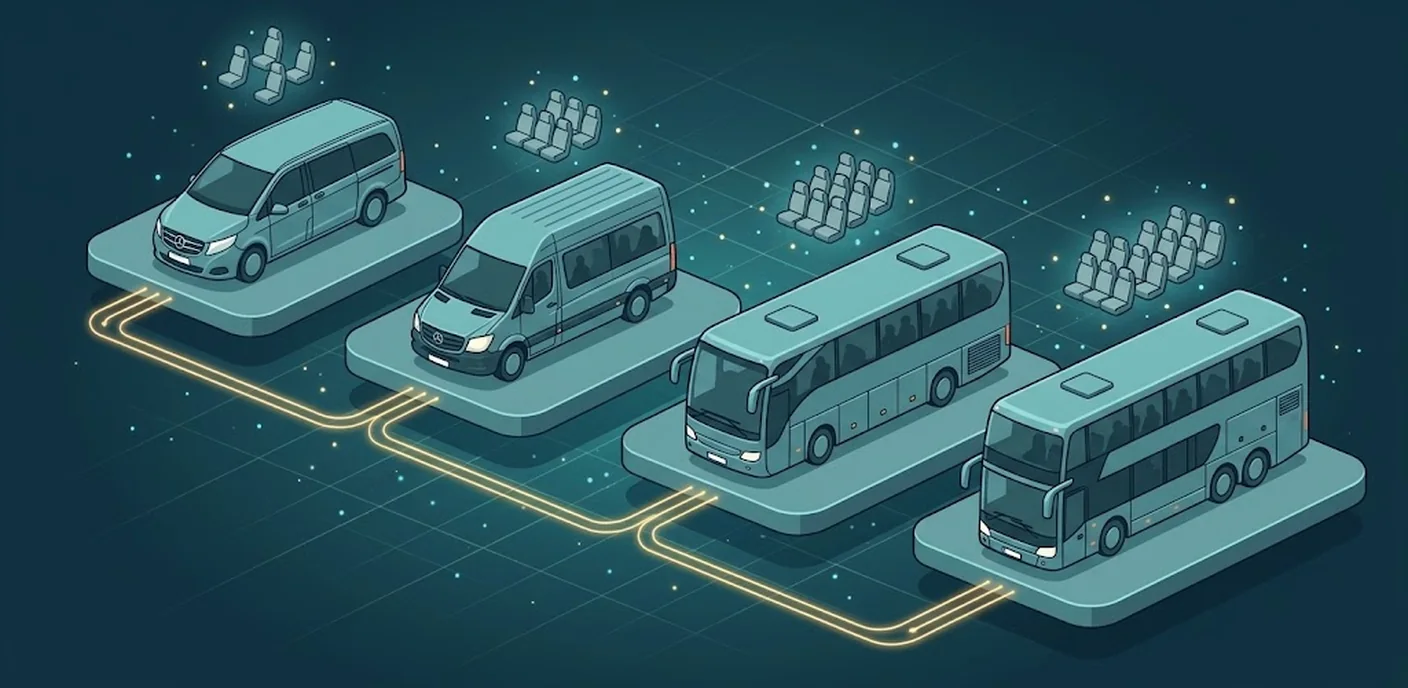
A standard coach has 48 to 53 seats. The full range runs from small coaches with 18 seats to double-deckers with 80. Below that sits the minibus with 8 to 17 seats, above it the double-decker with 60 to 80 – and for very small groups the business van with 3 to 6 seats.
What sounds simple on paper has a few catches in practice: not every seat is usable on every trip, luggage and wheelchairs take up space, and from 54 people the price suddenly doubles. Here is everything you need to know to pick the right bus size.
Which bus fits your group?
Enter group size, route and date – you get an instant price estimate for the right vehicle.
Seats by bus type
Business van: 3 to 6 people
The business van is more executive people carrier than bus – with driver, comfortable individual seats and room for hand luggage. It suits business trips, airport transfers and small families. It is not designed for more than six people.
Minibus: 8 to 17 people
The minibus covers the gap between van and coach. Depending on the model it offers 8 to 17 seats, usually with air conditioning and individual seats. The catch: at full occupancy the luggage space fills up quickly. Ideal for a day trip with backpacks; for a weekend with large suitcases, ask about luggage space or a trailer when you request.
Coach: 18 to 53 people
Smaller coaches start at 18 seats, the classic coach has 48 to 53. In between there are many variants, because manufacturers offer the same body with different seating layouts: more legroom means fewer seats. A coach with a galley, toilet or table groups often has only 44 to 48 seats, a pure transfer coach 53.
At the top end there are the large models: extended three-axle coaches such as the Setra S 519 HD, Mercedes-Benz Tourismo L or MAN Lion’s Coach L seat up to 63–71 people according to the manufacturers; in practice they usually carry 55 to 63 seats, because a toilet, galley and legroom cost seats. Far from every bus company has such vehicles, though – whether one is available in your region is only settled by the request. Our price estimate works with an average coach; especially just above 50 people, the offer can therefore deviate up or down depending on whether a partner can provide a large coach or needs two vehicles.
That is why it pays to state the exact number of people in your request rather than just "coach" – then the operator knows which vehicle in the fleet fits.
Double-decker: 60 to 80 people
The double-decker is the answer for groups that outgrow a normal coach. 60 to 80 seats in one vehicle, the largest models such as the Setra S 531 DT or Neoplan Skyliner up to 85–90 – often cheaper per head than two coaches, and the group stays together. Double-deckers are not available in every region, though, so early requests are essential.
VIP bus and nightliner: fewer seats, more space
VIP buses and nightliners trade seats for comfort: leather armchairs with plenty of legroom, tables, lounge areas – on a nightliner, bunks instead of rows of seats. Capacity here depends entirely on the fit-out of the individual vehicle. For these bus types there is no way around a specific request – and for the nightliner, around a long lead time: there are only a few operators in Germany, mostly booked by tours and event agencies. It is not meant as a hotel substitute for a private trip.
Why the seat count is not the whole truth
Every person needs a seat with a belt. There is no standing room on a coach – and that applies to children too. A coach with 50 seats takes 50 people, not 52.
The driver does not count. The seat count refers to passengers. The driver's seat is extra, and many coaches also have a separate tour guide seat at the front. If a chaperone wants to sit at the front, say so in the request.
Luggage does not take a seat, but it takes space. A standard coach usually holds one large suitcase per person in the luggage compartment. With ski trips, band equipment or club gear it gets tight – then a trailer or a coach with more storage helps.
Wheelchair spaces reduce the seats. A wheelchair space needs the area of several seats. If someone travels in a wheelchair, state it in the request – not every coach has a lift, and the usable seat count changes.
Choosing the right size
The most expensive mistake is a bus that is too small. Anyone who books a 48-seat coach for 50 people ends up needing a second one – and pays almost double. Three rules of thumb:
- Count precisely. Number of people including chaperones, teachers, coaches. Children count in full.
- Allow for latecomers. If the group might still grow, request the next size up straight away. A coach for 40 costs hardly more than one for 30 – the price per head even drops.
- From 54 people it becomes structural. Then it is a large coach (if a partner in your region has one), a double-decker or two coaches. State the exact number and compare the offers.
What a bus costs at every size
The seat count determines the bus type, and the bus type determines the price. As a guide: a minibus with driver costs EUR 600 to 750 per day, a coach EUR 1,100 to 1,800, a double-decker EUR 1,600 to 2,000 – all including VAT. Per head it gets cheaper with every additional person.
We have concrete calculations for the most common group sizes in dedicated articles: minibus for 15 people, bus for 25 to 30 people and bus for 50 people. The full overview of all cost factors is in How much does it cost to rent a coach?
Conclusion
A coach has 48 to 53 seats; across all bus types the range runs from 3 to 80. What matters is not the theoretical capacity but the exact number of people in your group – including chaperones, luggage and special requirements. State those in your request and you get the right vehicle and avoid the most expensive mistake: the second bus.
Costs by group size
Concrete price examples for the most common group sizes.
Frequently asked questions
A standard coach has 48 to 53 seats. Smaller coaches start at 18. Every person needs their own seat with a belt; there is no standing room on a coach.
Depending on model and seating layout, 18 to 53. The classic coach has 48 to 53 seats; vehicles with a galley, toilet or table groups often have 44 to 48.
Yes, as large models: extended three-axle coaches such as the Setra S 519 HD or Mercedes Tourismo L seat up to 63–71 people according to the manufacturers, but in practice usually carry 55 to 63 seats. They are not in every bus company's fleet. State the exact number of people in your request – partners who have such a vehicle will respond; otherwise it is a double-decker (60–80 seats, the largest up to 90) or two coaches.
A double-decker offers 60 to 80 seats. It is the solution for groups that outgrow a normal coach and is often cheaper per head than two separate buses.
A minibus has 8 to 17 seats. From 18 people you need a coach.
No. The seat count refers to passengers. The driver's seat is extra, and many coaches also have a separate tour guide seat at the front.
Usually one large suitcase per person in the luggage compartment. For ski equipment, band gear or club equipment, mention it in your request – then you get a coach with more storage or a trailer.