Bus logistics software: plan and award large coach projects yourself
Festival shuttles, shift transport, trade fair logistics: as soon as a contract consists of dozens of connected trips, it has so far ended up with a middleman. There is now software for it – for organisers and companies who want to tender themselves, and for bus operators who want to run such projects themselves.
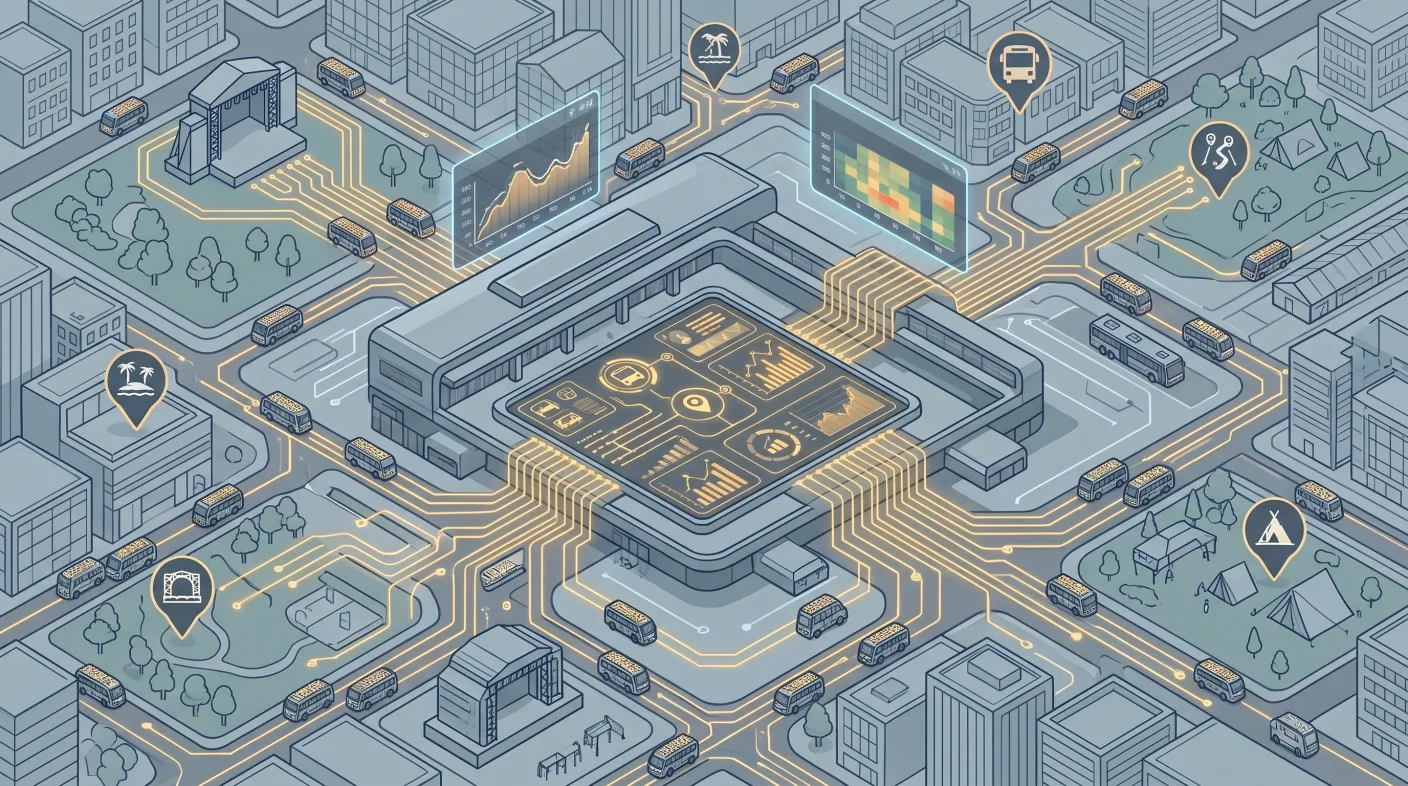
Large services are still planned in spreadsheets
A festival shuttle across a weekend, shift transport at a plant, a thousand visitors arriving at a trade fair: contracts like these do not consist of one trip but of dozens that depend on each other. They are nevertheless planned almost the same way every time – in a spreadsheet. After that: ten emails to ten bus operators, offers in five different formats, and three weeks later nobody remembers which trip has already been awarded.
Until now there was no tool for it. Anyone who had to put such a service together could choose between a spreadsheet and an agency that takes the whole thing on for a margin. That is exactly the gap the project module closes, and it is now available on both sides of the platform – for event organisers and companies as well as for bus operators.
Why large services end up with middlemen
The bottleneck is never the driving. Coaches exist, drivers exist, routes are not the problem. What is missing is the coordination: keeping forty items in view, bundling trips that belong together, making offers comparable, tracking deadlines, knowing at the end what is still open.
For that coordination there was no tool – so there was a job instead. Agencies take the request, pass it on and keep a margin for the brokering. What gets paid for is, at its core, organisation: keeping lists, collecting offers, reconciling dates. We have written elsewhere in detail about what this intermediate step costs.
And the price is only half of it. The other half: the client often does not know who actually drives. And the operator who does drive never meets the client. Both sides lose the relationship to a point in the middle whose only contribution was forwarding.
The project holds together everything that makes up one service
A project in Busly is not a folder and not a list of separate bookings. It spans one entire service: a name, a period, and beneath it everything that belongs to it.
Items are the content. An item is either a trip or an additional service – waiting time, on-site coordination, accommodation for the crew. A shuttle does not become forty-eight separate departures; it stays a single item defined by when it runs and how often. Anyone who has ever typed a shuttle service into a spreadsheet by hand knows why that difference matters.
Packages are the unit in which bus logistics actually works. Related items are bundled and handled together – tendered, awarded, invoiced. Pushing forty trips through the process one at a time would be the actual work; the package turns it into one operation.
Offers, bookings and invoices then hang off the same project. None of it lives in a second tool, an inbox or a folder on somebody else's computer.
For organisers and companies: plan it yourself, tender it directly
Whoever needs the coaches gathers in the project everything that has to be driven, bundles it into packages and puts it out to tender. The tender goes straight to the bus operators on the platform – companies with their own fleet, registered and verified, each with a profile, vehicles and past reviews.
What comes back are real offers, side by side and comparable. Only that produces a market price in the first place: a single quoted price can be compared with nothing. Four prices on the same package show what the service actually costs. If you need a rough figure up front, the bus cost overview gives you one within seconds.
Nobody sits in between taking a cut any more. You talk directly to the operator providing the coach and pay the price it quoted. Payment happens online, straight from the invoice.
We see this above all with services that run over days or weeks: visitor traffic at events, trade fair logistics, concert and festival shuttles, employee shuttles on a shift pattern, rail replacement services. Everything else is on the bus logistics page.
For bus operators: run large contracts yourself instead of passing them on
On the supply side the same project is a tool for taking on contracts you would otherwise have had to hand over. The operator creates its own trips and services, bundles them into packages and awards them – the customer price is set at that moment, and a multiple selection becomes one consolidated invoice.
Then comes the question of who drives. Is the own fleet enough? The feasibility check runs a whole package at once and names every trip with no vehicle available; the assignment itself happens in the calendar of the dispatch module. Whatever is left goes to subcontractors – to a specific contact, or via the subcontractor marketplace. Purchase price and customer price stay separate, so the margin is visible at all times.
The decisive point: the client stays your own customer. The margin stays in the house. And the fleet, the drivers, the contact book and the bookkeeping are the ones the operation already runs on, the same that the Busly software covers – none of it has to be kept up a second time.
Both sides work in the same project
Because client and operator work on the same thing, the paperwork gathers there too. Whatever one side uploads, whatever the other adds, whatever hangs off the separate bookings, plus the invoices – it all collects in the same project, every file with its origin, the trip it belongs to and its date. Questions run as messages on the order rather than in an email thread only one side can read.
That is the real difference to brokering: nothing gets passed along. Both see the same items, the same dates, the same status.
The overview shows where things are stuck
With forty items the hard question is not what to do, but what has been missed. So the project continuously checks a handful of typical cases and takes you straight there:
- Items nobody has tendered yet
- Offers waiting for a decision
- Tenders whose deadline is running out without a single bid
- Offers expiring within the next few days
- Bookings with no vehicle or driver
- Invoices that are outstanding or overdue
In practice
A service running over several weeks comes down to four steps:
- Create the project – name, period, location
- Capture what has to be driven: single trips, shuttles by time window and interval, additional services
- Bundle what belongs together into packages, set the offer deadline, put it out to tender
- Compare the offers side by side and award them – the overview keeps telling you what is outstanding
No second tool, no spreadsheet, no middleman in between.
Where this is going
The project module belongs to the platform and costs nothing – neither setting up an undertaking nor putting it out to tender, nor access to the operators that bid on it. There is no subscription, no setup charge and no percentage taken off the agreed price.
The thinking behind it is the same as behind everything we build: whoever needs a service and whoever provides it should be able to talk to each other directly. For a single trip that has long worked on Busly. From now on it also works for the service made up of forty of them.
If your next larger undertaking is coming up: as a client, start at bus logistics; as a bus operator, start at project management.
Set up your next large undertaking yourself
Create a project, capture the trips, tender it as a package – free, without a contract and without commission on the offer price.
Plan and tender bus logistics
For organisers and companies: every trip in one project, tendered as a package straight to vetted bus operators.
Project management for bus operators
Run large contracts yourself: calculate, dispatch, award to subcontractors, invoice.